
Introduction
How do you choose the right model for your home, what are the most important installation considerations, and what should you expect during the process? Whether you’re upgrading today or planning for the future, this guide will help you make informed decisions. Our third blog will cover maintenance and maximizing longevity.
Step 1: Sizing and Selection Criteria
Selecting a tankless water heater involves several key variables:
Flow Rate (GPM)
Your unit must deliver enough flow rate (gallons per minute) at the required temperature rise to meet your home’s needs. For example:
- Estimate peak simultaneous usage (shower + dishwasher + laundry).
- Consider the temperature differential (incoming cold water temperature vs target hot water temp).
- Choose a unit that can handle that rise and flow.
Fuel & Venting Requirements
- Electric models often are simpler to install (no venting needed) but may struggle if multiple fixtures run simultaneously or in colder climates.
- Gas/Propane models offer greater output but require proper venting (either direct vent or power vent) and adequate gas supply piping.
- Check your home’s current wiring, gas lines, and venting to ensure compatibility.
Efficiency & Features
- Look for high efficiency ratings (e.g., Energy Factor or Uniform Energy Factor).
- Consider additional features: digital controls, recirculation compatibility, remote sensors for multiple zones.
- Choose units with good service history and support for parts/maintenance.
Physical Location & Access
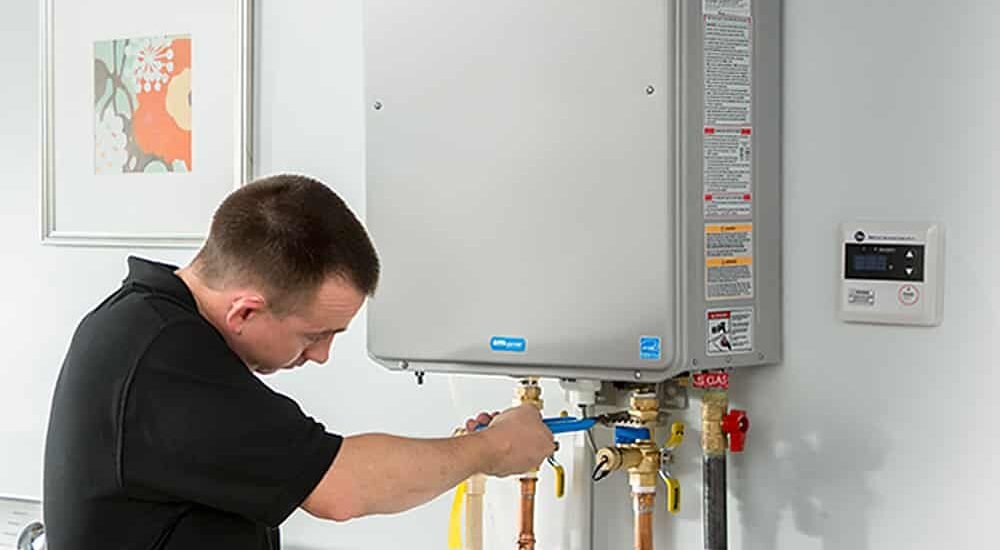
- The wall-mounted design of many tankless units means space is freed—but you’ll still need clearance for servicing.
- Ensure drain lines, venting, and gas/electrical access are planned.
- Consider noise and exhaust placement (especially in multi-unit or tighter spaces).
Step 2: What Happens During Installation?
Here’s a typical installation roadmap:
Pre-Installation Assessment
- Inspect the existing water heater and location.
- Verify venting, gas/electrical supply, piping, and drainage.
- Evaluate whether any upgrades are needed (e.g., larger gas line, electrical panel, vent piping).
- Select and order the correct unit based on sizing and specs.
Removal & Setup
- Shut off water, gas/electric supply, and drain the existing tank (if applicable).
- Remove the old heater and any associated components no longer needed.
- Install mounting bracket or supports for the new tankless unit.
- Connect venting per manufacturer and code requirements.
- Connect supply and return water lines, gas/electric feed, drainage for condensation if applicable.
Commissioning & Testing
- Start the water supply and purge air from the system.
- Check for leaks in piping, gas/electric connections, and drainage.
- Program or configure unit controls (temperature setting, sensors).
- Run hot water at multiple fixtures simultaneously to test flow, temperature, and stability.
- Provide operator orientation—how to adjust, what maintenance to expect.
Step 3: Common Installation Pitfalls (and How to Avoid Them)
- Undersizing the unit: If too small, you’ll experience inadequate hot water or inconsistent temperatures.
- Inadequate venting or gas supply: Especially for high-output gas models—requires proper piping and vent clearance.
- Hard water/mineral scaling: Without proper water treatment or maintenance, heat exchangers can scale, reducing efficiency and lifespan.
- Poor location or lack of service access: Make sure there’s enough space to service the unit, flush it, change parts.
- Ignoring simultaneous usage: If multiple showers, dishwasher, laundry run at once, you’ll need a higher capacity unit or dual units.
How This Installation Supports Long-Term Value
By selecting the right unit and installing it properly:
- You maximise your energy efficiency gains.
- You reduce the risk of early failure or poor performance.
- You free up space and improve usability of your utility area.
- You integrate the unit into your broader home plumbing and usage strategy (just like we discussed in Blog 1).
Ready to explore your tankless upgrade options? Visit our full service overview: Tankless Water Heater Services – Glendora, CA or contact us to get started here: Contact Us.
Conclusion
Choosing and installing the right tankless water heater is a smart investment—but the real payoff happens with proper setup and professional installation. Once it’s in place, you’ll want to keep it performing well.


